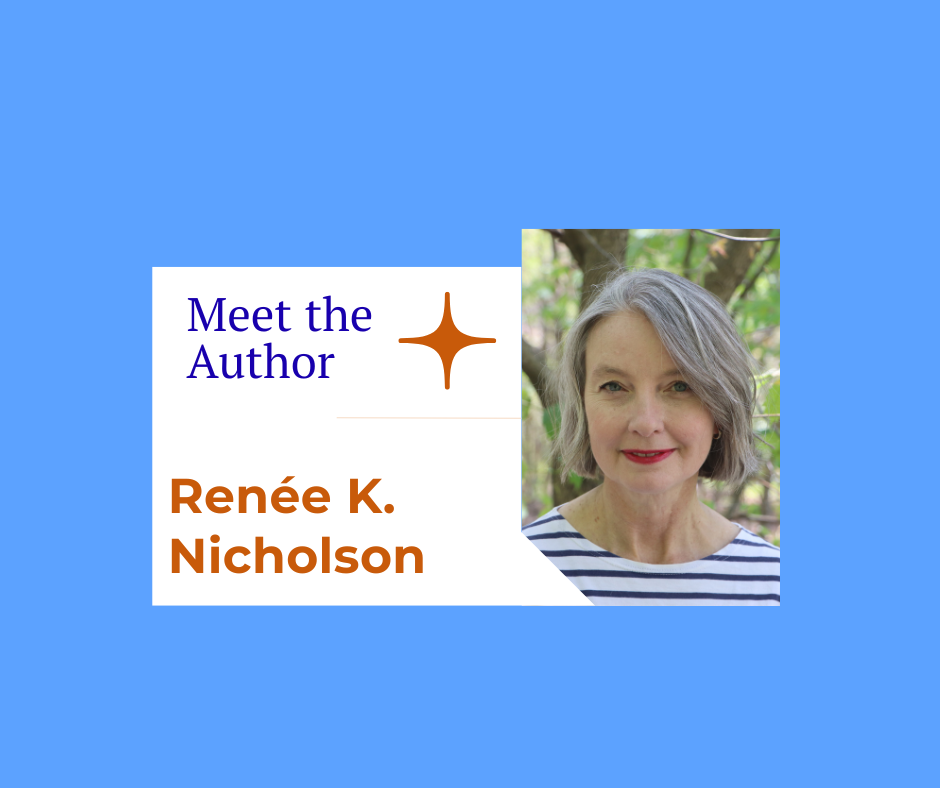
It’s a good day when we welcome a new author to Type Eighteen Books! Say hello to this multi-talented writer.
Renée K. Nicholson is a writer whose work spans poetry, essays, and fiction. She holds a B.A. in English from Butler University and an M.F.A. in Creative Writing from West Virginia University. The author of seven books, her most recent is the poetry collection Feverdream; her other titles include the memoir-in-essays Fierce and Delicate. Her writing has appeared in over 100 publications, including The Gettysburg Review, Bellevue Literary Review, New Ohio Review, and River Teeth. A voting member of the National Book Critics Circle and a 2026 Artist-in-Residence at the Château d’Orquevaux in France, Renée has a long-standing fascination with stories of resilience and reinvention. In 2024, she left a long career in academia to write full time and lives in Morgantown, West Virginia.
We gave Renée our usual Q&A, and her answers are fascinating:
Who are some of your favorite authors, and why?
Naming favorite authors is always tricky for me, because I read voraciously and on any given day, I might choose a different lineup. My earliest creative writing professor, Susan Neville, and my longstanding mentor John Hoppenthaler are certainly among my favorites, and they both instilled excellent reading-like-a writer habits in me: read for how an author uses language; notice how an author uses rhythm and structure in sentences; study first and last lines; pay attention to what’s left out and the weight of what’s not said; and study point of view, especially who is telling us the story and why.
Three writers with striking and strikingly different prose styles who take historical times and figures as their subjects are Paula McLain in The Paris Wife, Anthony Doerr in All the Light We Cannot See, and most recently, Devon Jersild in Luminous Bodies: A Novel of Marie Curie. I admire each of them for sentences that earn their beauty, and for how they deploy voice, structure, metaphor, restraint to show how the official or historical aspects of a life are never the whole story.
When did you know you were a writer?
I spent my childhood, youth, teens, and young adulthood training and performing in classical ballet, with no thoughts of writing. It wasn’t until I was at Butler University, where I did my undergraduate degree, that I encountered writing through an incredible six-author-a-semester reading series. The first person I heard was the Irish poet Seamus Heaney. It was the most amazing listening experience I’d ever had, and I thought: I want to do that. I enrolled in an intro-level creative writing class and went on to see so many incredible writers at Butler, including John Dufresne, Valerie Martin, Lorrie Moore, Nikki Giovanni, Michael Martone, and many others. Hearing these authors read their work aloud solidified in me the desire to write.
Still, even with encouragement, it took me nearly ten years after graduation to pursue my MFA. In those years I attended writing groups and conferences and read everything I could get my hands on. While in grad school, I wrote an essay that was pulled from the slush pile at The Gettysburg Review, and they paid me for it. I’ll never forget that, and I’ll always be grateful, because that’s when I felt I could call myself a writer.
Where were you born? Do you think the places of our lives inform our writing?
My father was a first-generation college student from Vienna, West Virginia, who put himself through college and grad school on an Air Force ROTC scholarship. He was stationed in Grand Forks, North Dakota, where I was born just a few days before Christmas. When my parents brought me home, it was -4 degrees out. I don’t remember it, and I’ve never been back, but I have always found snow and cold enchanting in a rather severe way, and I think North Dakota might be why.
While my father left the service, we never quite made it back to West Virginia to live, though we came to see family for major holidays and vacations. My family goes back seven generations in the state. I moved to Morgantown to do my MFA at WVU and never left, and I’ve now lived in West Virginia longer than anywhere else in my life. Both outsider and insider, it’s a complicated relationship. I both do and don’t belong, and this has come out in my writing.
However, I have also lived in South Florida, the Northeast, and the Midwest, and all those places have made their way into my writing, probably in ways I’m still discovering. In one of my journals I wrote down this quote from the poet David St. John, which I think speaks beautifully to the role of place in writing, and that I hope is true of mine: “Place in writing often exists at that intersection between the reality of place and one’s imagination about that place — what one believes, hopes, or imagines about the various possibilities of oneself in that place.”
Where would you vacation—city, country, beach, or mountains?
I love mountains, of course, and love going to West Virginia’s many beautiful state parks. I’ve enjoyed vacations to Scotland, Iceland, Ecuador, and The Netherlands, and I love going places to see art and museums. I went to the historic Vermeer exhibit at the Rijksmuseum for my 50th birthday. Unforgettable! But I’m also drawn most to stark and dramatic landscapes.
What do you think is the most important part of storytelling?
For me, there’s an important and inevitable tension between narrative voice and what’s at stake for the protagonist, and it must be established quickly. A reader will grow bored if these aren’t in place from the earliest moments. Uncertainty makes us curious but following a compelling and a particular voice pulls on that curiosity and gives it somewhere to go. Voice without tension is style without momentum and can read as tedious, even showy. Pure style forgets that readers want to spend time with someone and a situation that feels like it matters, even if it’s quiet. When a compelling tension is paired with a voice readers come to trust, not because it’s unbiased or always reliable, but because it’s consistent and compelling. Then, the story earns the reader’s full surrender.
Visit Renée’s website HERE.
